

Engineering
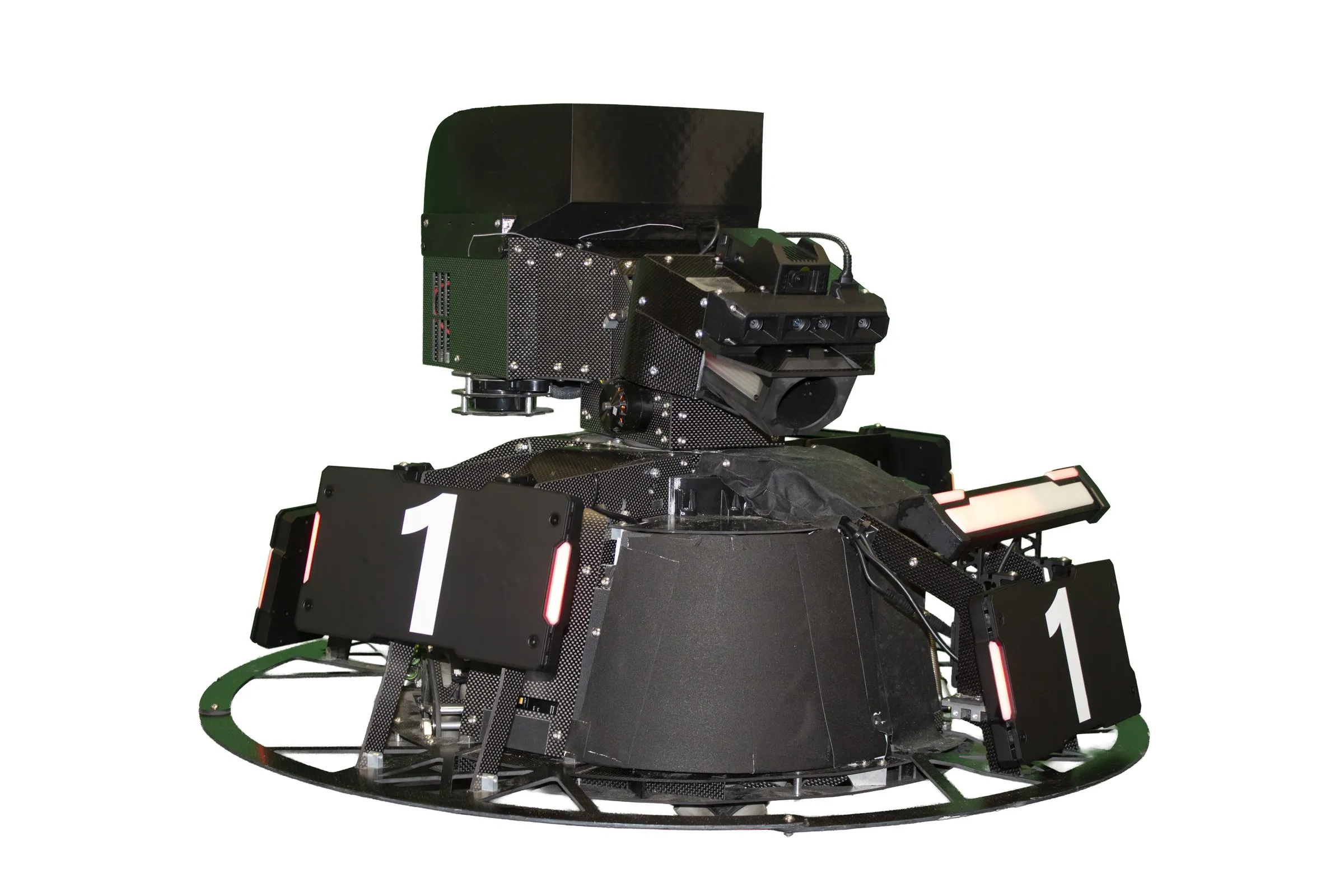
ARC is a university robotics competition based on DJI RoboMaster, where robots launch projectiles at each other to deduct HP. The design of the robots is open-ended, with some limits on size, weight, and power draw. Students design and build the mechanisms, electronics, controls, and vision software to rise to the challenge of each year's competition.
01
Mechanical Design
Robots need reliable mechanical platforms to operate in the field. This includes rapid projectile feeding, accurate launchers, and all-terrain suspension. Students model their designs in CAD, run structural analyses, and design to integrate sensors and actuators. They then bring their designs to life via machining, 3D printing, and carbon fiber layup. Some key innovations of teams include pivoting from star-type to screw-type feeders, which trade lower fire rate for higher torque margins and FOD tolerance, and modularizing launcher components for rapid replacement during match intermissions.
02
Electrical Hardware
Robots require both compute and power electronics to compete effectively. Students design and test these circuits with tools such as Altium and LTspice. Teams commonly embed STM32 microcontrollers with CAN and UART communication, as well as NVIDIA Jetson vision computers. Supercapacitor arrays supply short bursts of power, allowing teams to temporarily exceed the regulated power limits. These dedicated supercapacitor control boards must manage simultaneous charging and discharging.
03
Firmware, Controls, and Embedded Systems
Most robots run student-written software on STM32-based microcontrollers, communicating with motors and encoders over CAN and UART. The embedded application, IO, telemetry recording, and management of control loops are all implemented in the firmware. Students then study the robot's physical parameters to implement control algorithms such as PID and LQR to actuate the robot. For turret control, an inverted Simulink model can supply feedforward, with PI feedback added to account for model imperfections.
04
Computer Vision and Simulation
Robots deploy computer vision auto-aim systems to automate target acquisition and engagement, a necessity to be competitive at the highest level. The Sentry is fully autonomous per the rules, and must also auto-navigate. Teams employ machine learning, classical vision, and spatial prediction. For auto-aim, keypoint models can train on generated, heavily augmented armor plate images. For auto-navigation, teams can use a combination of AprilTags and LiDAR to localize and navigate in the field. Simulation is used to test vision and navigation algorithms before deployment on the robot.
05
Design Cycle and Project Management
All ARC teams are student-led groups. Students organize into a leadership structure to manage projects, define requirements, hold design reviews, and use Scrum and Agile to meet season deadlines. Teams bring singular designs from requirement collection, development and subsystem prototyping, detailed analysis and design, build, and integrated testing on robots. Teams must also pass a series of assessments to demonstrate their adherence to robot safety and competition fairness rules.
06
Business and Administration
ARC teams are organized and funded entirely by students. Members lead peers, manage budgets, organize events and travel, and raise money, usually through corporate sponsorships or university grants. Teams also manage their own public relations, including social media, press releases, and outreach to local schools. Students gain valuable experience in leadership, teamwork, and communication.